

The Problem
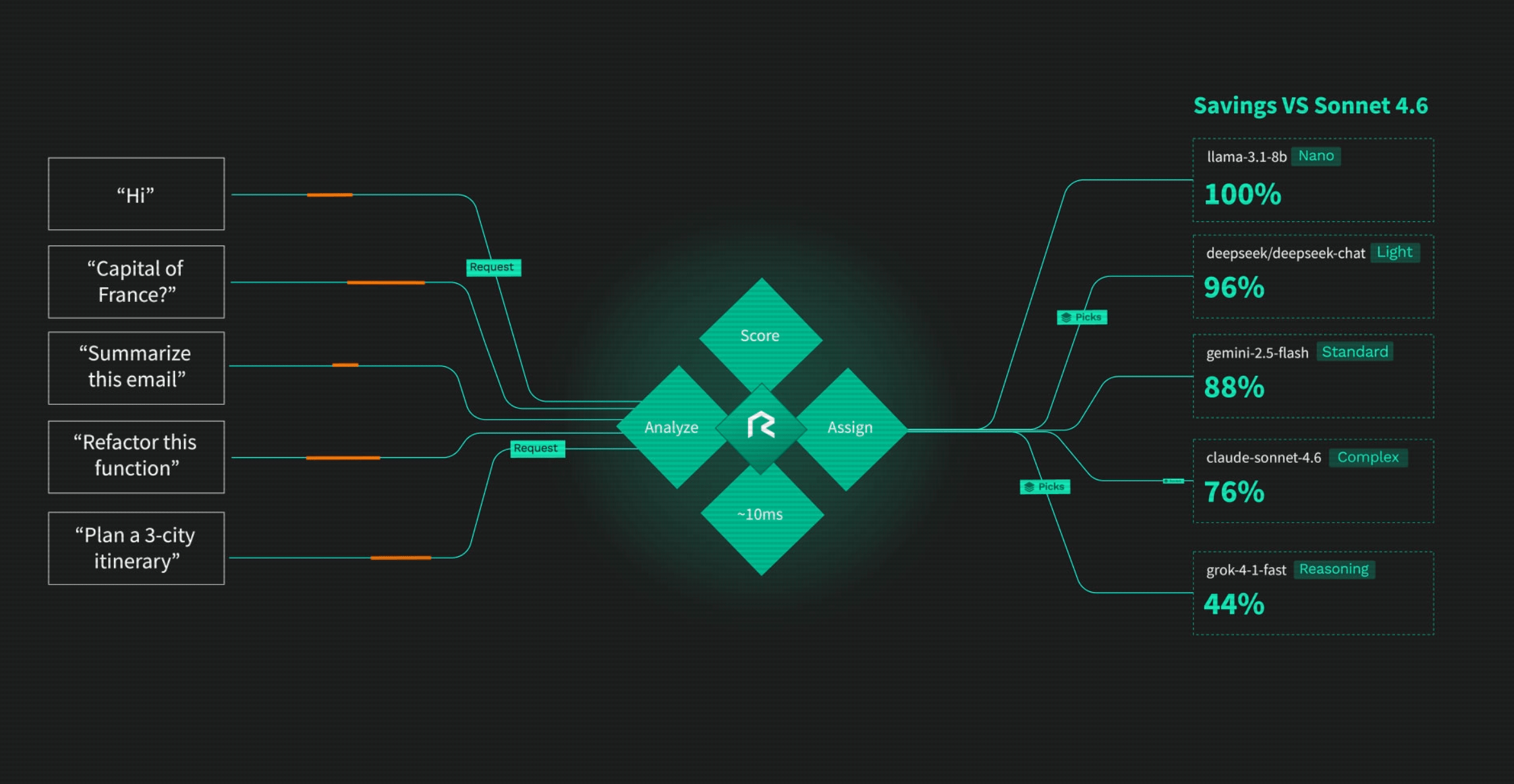
Most teams pick one model and send everything there. Casual questions, quick lookups, complex reasoning tasks. Everything hits the same expensive endpoint. That is where the money goes - and it is largely unnecessary. Open-weight and efficient models (GLM-5.2, Kimi K2.6, DeepSeek V4) now match flagship models on most production tasks. Across a real mixed workload, routing to the right model instead of the biggest one measures out to a 96.2% vs 95.8% task completion rate and a 4.31 vs 4.28 quality score - a difference inside measurement noise - while cutting cost 61-80% depending on workload type. Real savings depend on your workload, typically 61-80%. The gap isn’t “cheap and worse,” it’s “cheap and almost identical, except on the requests that actually need the expensive model.” The pricing gap between the cheapest capable model and the most expensive is roughly 200x:
*Illustrative request of 1,000 input + 500 output tokens. Real savings depend on your workload, typically 61-80%, with quality impact within measurement noise (task completion 96.2% vs 95.8%).
Sending everything to Claude Opus 4.8 or GPT-5.5 when 60% of your requests could go to a $0.20 model is the most common and most expensive mistake in AI development today. “Lower quality” on the cheap end only applies if you send hard tasks there - Routor’s entire job is making sure you don’t.
And when that one provider goes down, your entire product goes down with it.
The Agentic Loop Problem
Agentic workflows make this worse, not better. An agent loop calls a model once per step - plan, call a tool, read the result, decide the next step, repeat - and almost every implementation sends every single one of those steps to the same frontier model, regardless of whether that step was “write a production function” or “does this JSON have anid field.”
A 20-step agent run at frontier pricing pays frontier price 20 times, even though most of those steps are trivial routing and bookkeeping decisions a much cheaper model handles identically well. The cost of “agentic” products scales with loop count, not task difficulty - unless something in the loop is actually choosing the model per step.
Why You Can’t Just Pick Manually
Even a team that knows all of this cannot solve it by hand. Picking the right model means getting right, per request: the task category, the difficulty within that category, which of 30+ models across a dozen providers is currently best-value for that combination, and what that model currently costs - and then re-deciding all of that as new models ship and prices change weekly. That is not a one-time engineering decision, it’s a continuous optimization problem across category × difficulty × price × quality, which is exactly the kind of problem that needs to be automated rather than guessed at per request.The Landscape in 2026
A few things have changed that make routing more important than ever: Anthropic now leads in enterprise adoption. As of April 2026, Anthropic surpassed OpenAI in business AI adoption - 34.4% vs 32.3% - driven by Claude’s strength in coding, long context, and reliability. Claude Opus 4.8, released May 2026, is currently ranked the most capable AI model available. Claude Code ranked first among developer tools in a survey of 15,000 developers. Open-weight caught up. GLM-5.2, Kimi K2.6, and DeepSeek V4 match or exceed earlier flagship models on most production tasks - at a fraction of the price. There is no reason to pay premium rates for the majority of your requests. The model count keeps growing. More providers, more models, more pricing tiers. Picking the right one manually for every request type is not a realistic engineering task. Routing is infrastructure now, not an optimization. Single-provider bets are getting riskier. Anthropic has had multi-model error-rate incidents this year, and every other major lab has had a comparable one. On top of that, providers have started throttling or pacing rollouts as demand outpaces available compute. Betting a whole product on one vendor now risks both reliability and access, not just price. It is part of why a meaningful share of developers say they deliberately spread work across more than one AI vendor instead of standardizing on one. Aggregators are not the same as a routing decision. Marketplace-style products that expose hundreds of models through a single API keep raising funding, which confirms teams want one integration point. It does not mean an undifferentiated catalog solves overspending - it just moves the “which model do I use” decision onto the developer instead of answering it.What Routor Does
Routor analyzes every request in a few milliseconds and sends it to the best-value model that can handle it well - balancing quality and cost, not just picking the cheapest. If that model fails, it silently tries the next one in a ranked fallback chain.
Savings are measured against a baseline of routing everything to Claude Opus 4.8 - the common “default to the strongest model” pattern. You change one line of code. Everything else is automatic.
What You Get
- More than 60% lower costs on real workloads
- No downtime with automatic failover across 13 providers
- OpenAI-compatible API - nothing in your codebase breaks. An Anthropic-compatible endpoint is also available for Claude Code and other Anthropic-format clients
- Dashboard with live savings, usage, and provider health
- Playground to test routing decisions before they hit production
- 13 providers and 32 models all behind one endpoint
Where to Start
Migrate in 5 minutes
Change three lines of code - API key, base URL, model name. Your app routes intelligently immediately.
Understand routing
See how intent-based routing analyzes each prompt’s category and picks the best-value model for it.
Tune behavior
Create a routing profile with a custom tier range, cost cap, and capability requirements.
Browse the API
Full reference for
/v1/chat/completions, streaming, routing parameters, and the response format.Use case guides
Step-by-step configs for chatbots, code assistants, and customer support automation.